Wednesday, November 14, 2012

UNDERGROUND


Underground
Illustrated and Written by: Shane Evens
Roaring Book Press, 2011
29 pages
Historical Fiction 
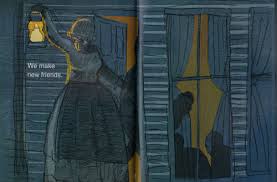
       I chose to read this book after it was recommended by Mrs. Strain.  The book is written poetically and its setting takes place in the 1960's during the underground railroad. The  book is about a family of slaves who escape in the darkness in the search for freedom by running and crawling toward the light. The light represents freedom. Although the story is very short it provides readers with emotion and descriptive details through simple wording. 

      The illustrations in this story assists the wording in showing readers the motions and the emotions that are involved in the journey. The coloring is very simple and they look to have been created using pencils and or paints. The text is in large print and are informally placed. I personally love the simplicity or both the text and the illustrations, for their simplicity still  provides so much meaning. I, however, am not the only one who loves these illustrations, for the installations are Caldecott winning.  

    I would recommend this book for students in kindergarten though third grade. Although the story seems simple it contains a deep meaning and I would use that to teach students the power in writing. I would also use this book as the introduction to the underground railroad and slavery.For a higher level of thinking, I might ask students to discuss what they believe freedom meant for these people.  I personally enjoy looking deep within this book and would definitely include it in my classroom library.  


THE LITTLE RED HEN AND THE PASSOVER MATZAH 


The Little Red Hen and The Passover Matzah
Written by: Leslie Kimmelman
Illustrated by: Paul Meisel
Holiday House, 2010
29 pages
Multicultural

            I chose to read this story because I am unfamiliar with the holiday Passover and I became  curious  about it after seeing this book.  For eight days every spring, the Jewish culture celebrates Passover as a symbol of freedom. In The Little Red Hen and The Passover Matzah a little hen prepares for the first dinner celebration of Passover, Seder. To prepare, the little hen decides that she wants to make matzah; therefore, the little hen begins by planting wheat. The little hen asks her friends to assist her, but they only say things such as "not I,"and "sorry, bub." So, the little hen does it herself. As time passes, the little hen continues harvesting her wheat and for each step of the harvest she asks for assistance from her friends, but every time they give the same answers. When the first day of Passover finally arrives, the little hen makes her matzah and sits down to enjoy her meal. As she is sitting, the little hen's friends arrive wanting to join her for the meal. The little hen doesn't want to let her friends join her because they didn't  help her, but she decides to let them in the spirit of the holiday.  After the meal, it is time to clean up and the little hen says "not I."So her friends finally help out and clean up. 

            The illustrations in this story were beautifully done in pastels and watercolors. The text, however, is placed informally. From page to page the illustrations take you though the steps of the harvest while showing the humor of the characters.   

           This story has not won any awards, but it would make an excellent multicultural addition for a classroom library. Along with the story, the book contains a passage in the back telling all about Passover, a glossary, and a matzah recipe. I would recommend this story for grades second and up and I would use this story as a way to teach students about Passover. This story could also make a good discussion on friendship and character education. 


Sunday, November 11, 2012

MY NAME WAS HUSSEIN 

My Name Was Hussein
Written by: Hristo Kyuchukov
Illustrated by: Allan Eitzen
Boyds Mills Press, 2004
28 pages
Multicultural

            This book was recommended to me by the Anniston librarian. The book is about a young Muslim boy named Hussein who loves to celebrate the holiday Ramadan. The book goes into details of the holiday and its traditions. Hussein lives in southeastern Europe after the Second Word War. During this time the communists took over and required that all Muslims change their names to Christian names. Therefore, as Hussein is celebrating his holiday that year he encounters soldiers with guns and tanks. The men force Hussein’s family to change their names, but Hussein is proud of his name for it means handsome. Form that day on Hussein is to be known as Henry and the story shares the emotions that this creates.

            The illustrations for this story were done using pens and watercolors and the text is placed formally. In order to capture the time and the emotion the coloring is done primarily in dull colors. I personally feel that the author and the illustrator worked well together in creating the imagine of the holiday traditions, the emotion, and the history. The story was actually based off of facts and the life of the author who used to be named Hussein.

            The book has not won any awards, but it is a wonderful story to use in the classroom for young readers. If used in the classroom one could use this story to talk about the Muslim religion, the history in Europe, or Ramadan. I would also use this story in talking about the author and his experiences during the time period in which this story took place. For older students, I would have them research this time period to attain further information about what went on in southeastern Europe.  


THE JOURNEY

The Journey
Written by: Sarah Stewart
Illustrated by: David Small
Berryville Graphics, 2001
32 pages
Multicultural

            I chose to read this book because of its unique qualities. Unlike most stories this one is told by letters and illustrations only. The story is about an Amish girl named Hannah who travels on a bus to the city for the first time. In each letter Hannah compares her experience to what it’s like at home and then signs her letter to my silent friend. For instance, Hannah compares the dresses at a clothing store to the ones in which her aunt makes for her. As the letters continue the reader is able to see how Hannah misses the simplicity of home even though she is mesmerized by the city.  

            The illustrations in this book are done, I believe, using pencils and watercolors. The text has been formally placed in order to appear as a letter. Under each letter, the illustrator drew Hannah as she is writing each letter. Besides the illustration of Hannah writing each letter, the illustrator adds to the story by showing the comparisons. Alongside the letters, the illustrator creates the image of what Hannah is seeing in the city. Then every other page is only illustrations and they create the image of what it is like for Hannah at home.

            The story has not won any awards, but it was created by an award winning team. I personally would recommend this story for student in about third or fourth grade. If used as a read aloud, one could use this story for comparing and contrasting the city life to the urban life. Also, one could talk about the life of the Amish people or one could use the letters for teaching grammar. 

Thursday, October 25, 2012


THE LIGHTNING THIEF


The Lightening Thief
Written by: Rick Riordan
Penguin Group Publisher, 2005
375 pages
Fantasy

A coworker suggested that I read The Lightening Thief a few months back when I was talking about watching the movie. I was told that I must not watch the movie unless I have read the book first. The Lightening Thief is about a twelve year old boy named Percy Jackson who is the son of a mortal woman and the Greek God Poseidon. Percy, Annabelle (daughter of Greek God Athena), and his protector Grover (half goat and half man) set out on an adventure to find a stolen lightning bolt. The lightning bolt holds enormous amounts of power and being in the wrong hands would create huge destruction to the word.  During their journey, Percy and his friends discover their powers and encounter several mythological enemies along the way. My personal favorite encounter was when Percy came across Medusa. Medusa is a creature with snack hair and if looked in the eye will turn one onto concrete. 


Since, The Lightening Thief is a chapter book, there are no installations. However, the text is formally written. There has been a movie made about the story, but it is slightly different.  The characters in the movie are older, modern, and less personalized. In order to get a deeper incite on the characters and to learn of more details in their journeys, one must read the book.  

          The Lightening Thief has been nominated for several awards and was ranked ninth on The New York Times Best Seller list for children books. I would include this book in my classroom library, but it is a book directed more for children ages 12 and up. When read aloud to an upper elementary class I would have students' talk about character building and have the students relate with Percy or Annabelle.  With time permitting, I would also like to view the movie along with the book to have students compare and contrast between the two. Lastly, I think the book would be a great piece to use when talking about mythology. 


BAT’S BIG GAME


Bat’s Big Game
Written by: Eugene W. Field
Illustrated by: David McPhail
Scholastic Inc. Publisher, 2004
24 pages
Fantasy  

             I came across this story while looking for another story that features bats and I ended up being drawn to this story. Bat's Big Game is actually the simplified retelling of Aesop's fable. The story is about animals and birds who decide to play a game of soccer. The animals are team A and the birds are team B. Bat comes along and decides that he wants to play as well and decides to join the team in which he believes will win; the animals. However, after convincing the animals that he is as well an animal, Bat discovers that the animals are losing. So, Bat decides to convince the birds that he is a bird and join their team. Eventually, both teams learn about Bat's plan to be only on the winning team and force him to chose one and stick with it. 

            The illustrations in this story were created digitally and the text is placed in an informal placement. 

            Although the story has not won any awards it does have excellent morals and qualities. I believe this story is appropriate for children preschool to third grade. I would use this story to teach students how to be a good team player. As Bear says, "a good player sticks with the team...even when they are losing."Also, even though animals cannot really talk, the story does have facts within it about the different animals. 


SLEEPING BEAUTY

Sleeping Beauty

Retold By: Mahlon Craft
Illustrated By: K.V. Craft
North Star Publishing, 2002
29 pages
Traditional Literature

            I chose to read this piece of traditional literature because of its beautiful and magical illustrations. Unlike most sleeping beauty stories, Maholon and K.V. Craft (husband and wife), bring the story to life. The writer and illustrator takes the typically simple story and enhances it into art. The story begins when a beautiful Queen, who's one desire is to have a child, meets a magical frog who tells her she is to have a daughter. Just as the frogs predicts, the King and Queen have a daughter and name her Aurora. During the celebration of their daughter, fairies come to grant Aurora with magical gifts; however, one evil fairy presents the gift of a curse. On Aurora's sixteenth birthday she will fall asleep eternally and the curse can only be broken by the kiss of true love. 100 years later Aurora finally is presented with her true loves kiss and, as all fairly tales do, lives happily ever after.

            For the illustrations, K.V. Craft, uses oil over watercolor paintings to bring out the classical characters that where inspired by Baroque paintings. I personally feel that the illustrations bring a historic feature to accompany the text. The text for the story is done in the most formal form, for it is opposite of the illustrations. Even though the story has not won any awards it has been recognized for its illustrations and the illustrator is a multiple award winner for other pieces. 

           I personally enjoyed this version of the fairy tale for it brought new meaning and incite on the story. When used in a classroom I would use it to teach traditional literature and use it to create a comparing and contrasting piece. I also, would use this story for mythology projects, art, and multicultural  The reason for using it as a multicultural piece is because of the written form and the accents in which are included within the text wording. I believe this story can be used for children of all ages.